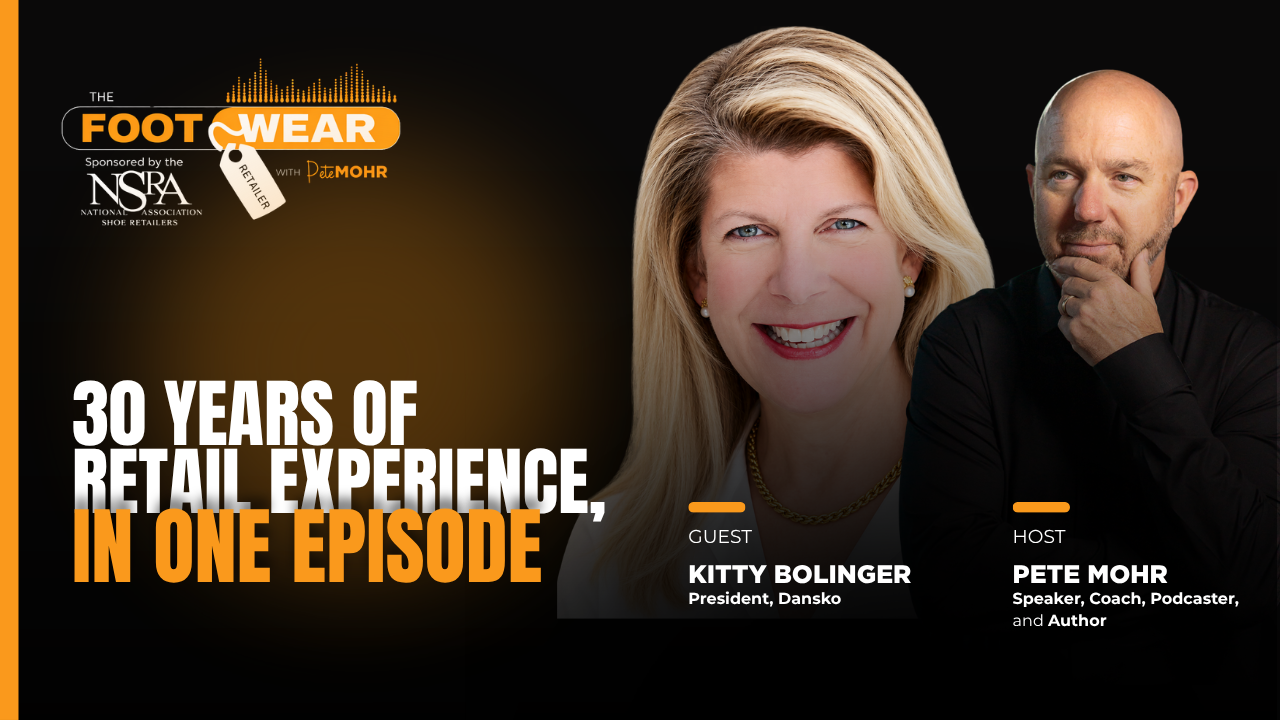
Dansko President Kitty Bolinger on why culture — not product — is the real difference between a good footwear brand and a great one, and what thirty years in the industry taught her about leading people.
Every brand says it cares about culture.
Fewer can point to the year they became legally, financially owned by the people who work there.
Dansko can. 2012. Every employee, an owner.
In this episode of The Footwear Retailer Podcast, I sit down with Kitty Bolinger, President of Dansko, to talk about what it actually takes to build a culture that holds up as a company grows — and why she still gets out from behind her desk to spend time with the independent retailers who sell her shoes.
Kitty has been in footwear for more than thirty years. She’s been a department-store buyer, a wholesale rep, an independent retailer herself, and now she runs one of the most recognizable comfort brands in the business. That’s a lot of vantage points on the same industry, and it shows in how she talks about it.
A Career That Didn’t Go in a Straight Line
Kitty’s path into footwear started the way a lot of retail careers used to start: a corporate buyer training program, straight out of college in the mid-1980s.
She landed at Strawbridge & Clothier, a regional department store in Philadelphia, and worked her way from assistant buyer up through footwear — Naturalizer, Selby, Easy Spirit at launch, Rockport at launch.
“It was the comfort brand before there was comfort,” she says.
It wasn’t the most glamorous corner of retail. But it taught her the business from the ground up.
Eventually the desk started to feel like the wrong seat. She noticed the sales reps and tech reps who came through the stores and realized that looked like more fun than buying. So she went after a tech rep role at Timberland and made the jump to wholesale in the early 1990s.
Then she did something a lot of people in her position wouldn’t: she went back to independent retail for three years, because she fell for one of her own independent retailers and they offered her a job.
“I’ve kind of bounced around a little bit,” she told me, “figuring out which was going to make my life work better.”
That restlessness is part of what makes her perspective valuable. She’s sat on almost every side of this business.
Why She Still Gets Out From Behind the Desk
Kitty joined Dansko in 2010 as National Sales Manager. Today she’s president. And she still spends a meaningful chunk of her time out visiting independent retailers — not because she has to, but because she says she learns something every single time.
Sometimes it’s a color that was wrong. Sometimes it’s language that didn’t land. Sometimes it’s just listening to the associates on the floor to find out what they actually talk to customers about.
“I learn every time I walk into an independent retailer.”
One thing she pointed to that surprised me: running specialty stores, even ones that don’t carry Dansko, as some of the best-trained retail environments in the industry — because athletic brands invest heavily in tech reps and training. Her advice to any independent retailer listening was blunt: make sure your brands are coming in and training your people. That’s the differentiator.
“A good retailer and a great retailer,” she said, “the difference is the people that are on the floor.”
Building a Culture That Actually Holds Up
Ask Kitty to describe Dansko’s culture and she doesn’t reach for a mission statement. She reaches for one word.
Family.
“It’s so corny,” she told me, “but it’s a family. We have dysfunction like every family. But I think it’s just that sense of everybody has each other’s back.”
That’s not just a line. In 2012, Dansko became 100% employee-owned. Every month, the entire company — including the distribution center across the street — shuts down for an all-hands meeting. Some months it’s simple: celebrating five-year work anniversaries. Some months it’s the valuation meeting, when every employee owner learns exactly what their shares in the company are worth.
Kitty also talked candidly about giving people permission to fail — and about how her leadership team, which is predominantly female, had to learn to challenge each other rather than defer, especially in that first year.
And the hardest part of her job, by her own account? Not doing anything.
“I have experts in each area,” she said. “If I try to step into that too much, well then why are they here?”
Leading Through the Hardest Year
Not every part of the conversation was warm and fuzzy. I asked Kitty about the toughest stretch of her time as president, and she didn’t hesitate: the tariff disruptions of 2025.
“That was quite possibly, for me from a professional standpoint, one of the most difficult times that I’ve been through,” she said. “You’re forced to make decisions so quickly, and you’re forced to reckon with things that are completely outside of your control.”
Her team pulled together — sourcing renegotiating with factories, finance rerunning every model — and when price increases became unavoidable, Dansko made a point of sharing that pain with its retail partners rather than passing along the full hit.
Around the same time, Dansko also drew a hard line on returning to the office four days a week, even though she knew it would make hiring harder. Her reasoning: some things are simply fundamental to how the company works, and you don’t bend on those just because it’s uncomfortable.
Getting Back to What Brought You to the Dance
One of the things Kitty said she’s most excited about right now is Dansko rediscovering its own origin story.
A couple of years ago, the brand realized its marketing had spent too much energy insisting it wasn’t just clogs — and not enough time embracing the fact that the clog, and the comfort and craftsmanship behind it, is exactly what built the brand in the first place.
“We are clogs,” she said. “And a whole lot more.”
Since refocusing on that heritage, Dansko has seen double-digit growth, year on year. Her takeaway: the differentiator was never the ability to make another double-strap, cork-bed sandal. Anyone can do that, and on Amazon, plenty of people do. The differentiator is the story of how you got there — and no competitor can copy that.
My Takeaway
You don’t build a thirty-year career, or a culture people describe unprompted as “family,” by accident.
Kitty’s conversation kept circling back to the same idea in different forms: get close to the people who do the actual work — your team, your retailers, the associates on the sales floor — and keep listening even after you’ve made it to the top.
And on the days when it all feels like too much, she has a line she uses on her own team that I’m going to borrow:
There has never, to anyone’s knowledge, been a shoe death in this country.
It’s footwear. Take the work seriously. Don’t take the panic seriously.
Listen to the full conversation with Kitty Bolinger and hear what thirty years in footwear taught her about building a company people actually want to work for.


0 Comments