
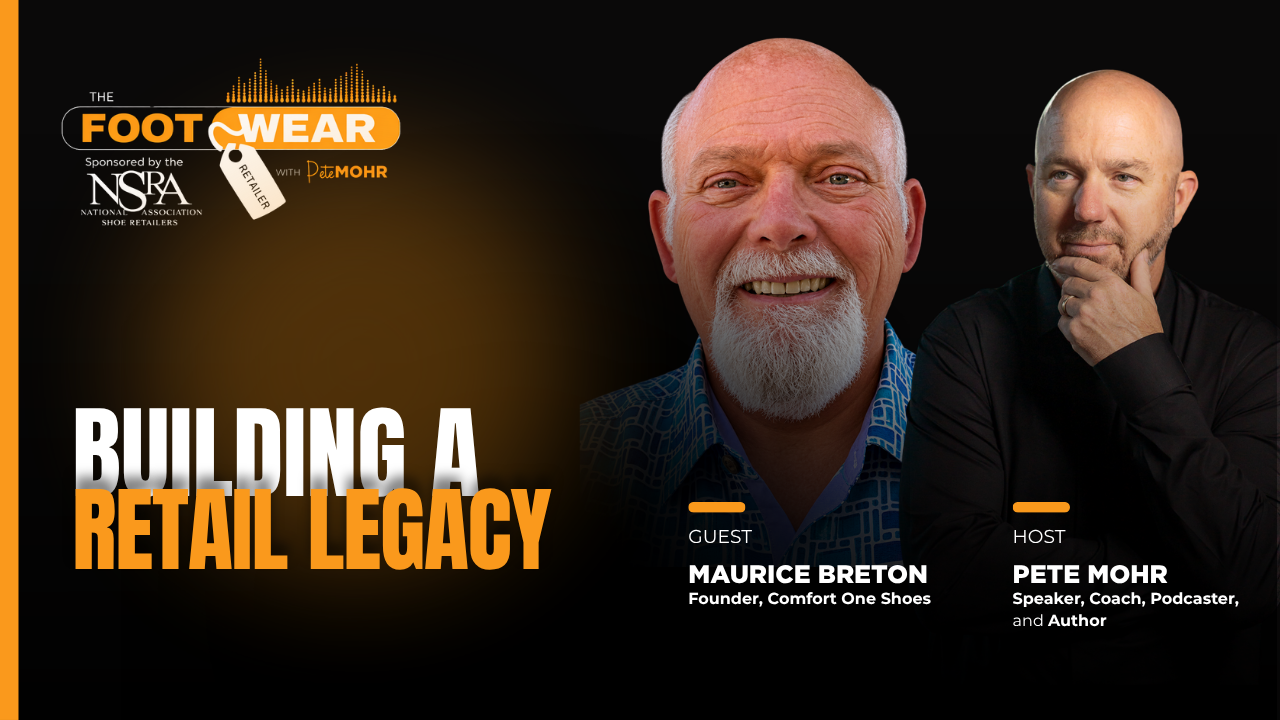
Veteran footwear retailer Maurice Breton shares the systems, standards, people, and decisions behind building a high-performing independent shoe business — and what today’s footwear retailers can learn from decades of experience on the sales floor.
What separates an average footwear retailer from a great one?
For Maurice Breton, the answer isn’t one big idea.
It’s the way you hire.
The way you train.
The standards you set.
The numbers you measure.
The products you choose.
The relationships you build.
And, most importantly, whether you’re willing to hold yourself and your team accountable for executing all of it.
Maurice has spent decades in the footwear business, first working in large-scale department store retail before eventually stepping away from the corporate world and opening his own store in Alexandria, Virginia in 1993.
From that first location, he went on to build a highly respected footwear retail organization known for its sales culture, employee training, customer experience, and strong relationships within the industry.
In Episode 30 of The Footwear Retailer Podcast, Maurice joins me to look back on the decisions that worked, the ones that didn’t, how he prepared his son Garrett to eventually take over the company, and what he believes the future holds for independent footwear retailers.
From Big Retail to Opening His Own Shoe Store
Maurice didn’t enter independent footwear retail without experience.
Before opening his own store, he spent years in the department store business and worked with footwear operations involving hundreds of stores.
That experience shaped the way he later approached independent retail.
He was accustomed to receiving reports.
Looking at numbers.
Getting feedback.
Questioning decisions.
Listening to criticism.
And analyzing what could be improved.
When Maurice moved into the independent footwear world, he noticed something different.
Independent retailers were exactly that:
Independent.
There wasn’t always someone outside the business looking at the operation and asking difficult questions.
Maurice brought that analytical mindset with him when he opened his first store on King Street in Alexandria on July 1, 1993.
That willingness to measure, question, learn, and improve became a major part of how he operated the business.
The Sales Floor Has One Very Important Job
Throughout our conversation, Maurice returns repeatedly to one fundamental idea:
If you’re in the shoe retail business, you need to be very good at selling shoes.
That sounds obvious.
But there’s a huge difference between having products available for customers and building an organization specifically designed to sell those products well.
Maurice focused heavily on what he called the quality numbers behind the business.
That included measurements such as:
- Sales per square foot
- Sales per hour
- Multiple-pair rates
- Conversion rates
- Attachment rates
- Individual salesperson productivity
These weren’t numbers that sat in a report somewhere and were forgotten.
Employees knew their goals.
They knew where they stood.
Managers had visibility into performance.
And Maurice believed strongly that people perform better when expectations are clear and they know exactly how they’re doing against those expectations.
Comfort One University Made Training a System
One of the most interesting parts of Maurice’s approach was the investment made in employee training.
The company developed what it called Comfort One University.
At one point, employees could move through 21 different classroom-based courses before being mentored by someone directly on the selling floor.
New salespeople weren’t simply hired, handed a name tag, and told to start helping customers.
They learned the company’s system first.
Then they practiced it.
Then their performance was measured.
That approach accomplished two things.
First, it gave promising employees the structure they needed to become effective salespeople.
Second, it helped the company recognize relatively quickly when someone wasn’t going to be a good fit.
Maurice didn’t expect every person they hired to succeed.
When the company was growing rapidly, they might hire ten people knowing that only two or three could ultimately become strong performers.
That was considered part of the process.
High Standards Only Work If You Hold People Accountable
Training was only one part of the system.
There were expectations after the training too.
Maurice describes having a proprietary ten-step selling program.
The company conducted secret shops to determine whether employees were actually following the process.
There were standards.
There were consequences.
And there were incentives for high performers.
Maurice’s belief was simple:
You can’t tell people something is important and then ignore whether or not they’re doing it.
Some of the company’s strongest salespeople ultimately sold more than a million dollars worth of footwear individually.
That kind of productivity wasn’t accidental.
It came from hiring people with the right attitude, teaching them how the company sold, setting goals, measuring results, and compensating top performers appropriately.
Don’t Just Bring One Pair From the Stockroom
One of Maurice’s best examples of sales-floor execution involves something incredibly simple:
How many pairs of shoes does the salesperson bring out?
He recalls speaking with another retailer who said the store had a non-negotiable rule requiring sales associates to bring three pairs onto the floor.
But while Maurice stood there observing the store, customers were being served and almost nobody actually followed the supposed rule.
That distinction matters.
Having a standard isn’t the same as executing a standard.
And footwear retailers have a limited number of customer opportunities every day.
If someone walks into the store during a slow Tuesday morning, Maurice believes the salesperson should make the most of that opportunity.
Bring options.
Show additional footwear.
Introduce accessories.
Show handbags where appropriate.
Give the customer an opportunity to discover something beyond the one item they originally requested.
The difference can be substantial.
Instead of ringing up one pair of shoes, a strong selling experience can turn a small transaction into a much larger one.
Find Good People — Then Give Them a Reason to Stay
Finding great retail employees has never been easy.
Maurice says the company didn’t necessarily look for people who already had footwear experience.
They looked for people who were genuine, capable, intelligent, and aligned with the kind of experience the stores wanted to provide.
Once those people demonstrated that they could perform within the system, the company gave them opportunities to earn.
Maurice makes an important distinction when discussing compensation.
He doesn’t describe it simply as what the company paid employees.
He describes what strong salespeople were able to earn.
That difference mattered.
The goal was to create an environment where successful retail salespeople could build careers, support families, buy homes, and stay with the company for many years.
Some employees stayed for decades.
Sales Contests Can Build More Than Sales
Commission wasn’t the only incentive.
Maurice says the company regularly ran sales contests.
The prizes weren’t always small.
There were trips.
Cash bonuses.
Travel to places like Europe and Hawaii.
And incentives tied to brands the company wanted to establish or merchandise that offered attractive margins.
The obvious objective was to increase sales.
But Maurice points out another benefit:
Contests can build energy and morale.
A good competition gives the team something to talk about.
Something to work toward.
And something to celebrate.
One of Maurice’s Biggest Mistakes: Waiting Too Long
Successful retailers make bad decisions too.
One lesson Maurice remembers came during the 2008 downturn.
The business had an infrastructure designed to support significant growth.
But instead of growing, sales were declining.
The numbers were changing.
The structure of the business needed to change with them.
Maurice admits he waited too long.
It wasn’t easy to make those decisions because the expenses that needed to be reduced often involved people and systems that had helped build the company.
But waiting didn’t make the eventual decisions easier.
It meant the adjustments had to become deeper.
There’s an important lesson there for independent business owners:
Don’t wait for a temporary problem to prove that it isn’t temporary before looking honestly at the numbers.
Sometimes Cutting Costs Improves the Business
During difficult periods, Maurice and his team questioned expenses throughout the organization.
Some changes initially felt uncomfortable.
Tasks that had been handled centrally might move back to individual stores.
Processes that had always been done one way had to be reconsidered.
But something interesting happened.
Not every cost reduction damaged the customer experience.
Some of the new processes worked almost as well as the old ones.
And in some cases, the business discovered that it had been spending money on things that weren’t producing nearly as much value as everyone assumed.
Periods of pressure can force retailers to question processes that would otherwise continue simply because:
That’s how we’ve always done it.
Preparing the Business for the Next Generation
One of the major themes of this episode is succession.
Maurice eventually sold the business to his son Garrett.
But the transition didn’t happen overnight.
Garrett had worked throughout the organization.
His roles included:
- Stock work
- Sales
- Assistant manager
- Store manager
- District manager
- Assistant buyer
- Buyer
- General merchandise manager
He also participated in major meetings, banking conversations, board discussions, and other areas of the organization that future leaders need to understand.
Maurice makes an important point about family businesses:
You can’t simply go from stockboy to president and expect everyone in the organization to automatically respect the transition.
The next generation needs experience.
They need exposure.
They need opportunities to make decisions.
And sometimes they need the freedom to make mistakes.
Sometimes the Hardest Part of Succession Is Doing Nothing
Maurice worked closely with Garrett for years before fully handing over leadership.
One of the more difficult parts was knowing that his son might occasionally make a mistake and choosing not to immediately intervene.
Maurice had already made thousands of decisions himself.
Some worked.
Some didn’t.
That’s how experience is built.
Garrett needed the opportunity to build that experience too.
For an experienced owner, sitting on your hands while the next generation learns can be incredibly difficult.
But there’s a point where succession stops being about teaching someone exactly what you would do.
It becomes about giving them enough knowledge, experience, and confidence to make their own decisions.
Succession Started With a Strong Balance Sheet
Maurice wasn’t only preparing Garrett.
He was preparing the company.
Before the transition, one of his priorities was building a strong balance sheet.
The company entered the end of 2019 with very low debt and millions of dollars in retained earnings.
That didn’t happen accidentally.
It required years of decisions about where money should — and shouldn’t — be spent.
The goal was to hand the next generation a financially healthy organization rather than simply hand over the title of president.
And the timing turned out to matter.
Garrett assumed his leadership role on January 1, 2020.
Then COVID arrived.
Maurice jokes that he expected his son to make some changes.
He just didn’t expect him to close all the stores.
Expose the Next Generation to the Things That Don’t Happen Every Day
Succession planning isn’t only about teaching everyday store operations.
Some of the most important responsibilities of ownership happen infrequently.
Lease negotiations are a great example.
A lease may only come up every five or ten years.
If the current owner always handles that conversation alone, the next generation can spend decades in the business without ever learning how it works.
The same is true for:
- Banking relationships
- Major vendor negotiations
- Legal agreements
- Real estate decisions
- Financing
- Board-level decisions
If someone is eventually expected to run the company, they need exposure to these decisions before the transition happens.
Build Relationships With Vendors That Matter to Both Sides
Maurice also credits strong vendor and factory relationships as an important part of the company’s success.
Early in the business, he developed direct relationships with factories in places such as Germany, Austria, Italy, and France.
Those relationships created opportunities for differentiated and sometimes exclusive products.
Rather than competing on exactly the same footwear every other retailer could sell, Maurice wanted merchandise that gave customers a reason to shop with his stores specifically.
That strategy also helped reduce direct price comparisons.
If a product is available everywhere online, customers can easily stand in your store and compare the price on their phone.
Exclusive or carefully controlled distribution changes that conversation.
The retailer can compete on product, fit, service, experience, and expertise instead of being reduced to a price comparison.
Maurice Would Go Even More Premium Today
If Maurice were opening his first store again today, he says he would still focus heavily on quality European footwear.
In fact, he’d probably go even more premium.
His reasoning is that the work required to sell a higher-priced shoe isn’t necessarily dramatically different from the work required to sell a less expensive one.
If the product feels better, looks better, performs better, and is difficult for the customer to find somewhere else, that creates value.
And higher average selling prices can matter as the cost of operating a store continues to rise.
Rent is higher.
Utilities are higher.
Payroll is higher.
Retailers ultimately pay those expenses in dollars, not in pairs of shoes.
Increasing the value generated from each customer interaction can help support those rising costs.
What Happens to Independent Footwear Retail Over the Next 20 Years?
Maurice believes the independent footwear industry will continue consolidating.
Not every store operating today will still exist twenty years from now.
Some owners will retire without successors.
Some stores will close.
Others will be acquired by stronger operators.
And larger independent groups may continue expanding.
But Maurice doesn’t necessarily view that future negatively.
He compares it to other retail categories where the overall number of stores has declined while the strongest operators have captured a larger share of the remaining market.
His expectation is that high-quality, well-run independent footwear retailers can survive and thrive precisely because there may be less competition.
The opportunity remains.
But average execution may become increasingly difficult to sustain.
Independent Retailers Should Talk to Each Other
Another theme Maurice returns to is collaboration.
His department store background taught him the value of outside information.
Even large organizations don’t know everything.
A report from another market could expose an emerging brand.
A conversation with another retailer could reveal something happening elsewhere in the industry.
Another experienced operator walking through your store might notice something you’ve stopped seeing.
Maurice says he freely shared many of his company’s best practices with other retailers.
Interestingly, that didn’t worry him very much.
Why?
Because knowing what to do and actually doing it consistently are two different things.
The systems that produced strong results required work.
Execution remained the competitive advantage.
Manage by Walking Around
When I asked Maurice about one of the most underrated things an owner can do, his answer was remarkably simple.
Walk around.
Maurice knew the people working throughout his organization.
Not only senior executives.
Salespeople.
Drivers.
Managers.
He knew about their families.
He made time for conversations.
And the company maintained an open-door philosophy when people needed help.
That didn’t mean every rule disappeared whenever an employee had a problem.
But it did mean management could occasionally use discretion when the circumstances justified it.
Rules create consistency.
Good leadership also requires knowing when a unique situation deserves a unique solution.
People Are Still the Key to the Business
After decades of stores, products, vendors, financial decisions, mistakes, successes, awards, and succession planning, Maurice ultimately brings the conversation back to people.
Great retail requires great people.
But hiring them isn’t enough.
You need to:
- Train them
- Give them clear expectations
- Measure what matters
- Provide goals
- Hold them accountable
- Reward strong performance
- Give good employees opportunities to earn
- Take an interest in them as people
Those ideas aren’t particularly complicated.
Executing them consistently is.
My Takeaway
One of the things I enjoyed most about this conversation with Maurice is how often seemingly complicated retail problems came back to fundamentals.
Know your numbers.
Train your people.
Set clear standards.
Watch what’s actually happening on the selling floor.
Build strong relationships.
Differentiate your merchandise.
Prepare your next generation before they need to lead.
And don’t assume that putting a system in place means the system is actually being followed.
Maurice describes retail as a difficult business.
His view is that if you’re already doing all the work required to operate at 80 percent, it isn’t dramatically more difficult to push toward 100 percent.
That extra effort is where better training happens.
It’s where standards become execution.
It’s where average customer interactions become great ones.
And over thousands of transactions, those small differences can become enormous.
Ask yourself:
- Does every salesperson know exactly what good performance looks like?
- Are you measuring the numbers that actually drive profitability?
- Does your training continue after an employee’s first week?
- Are your sales-floor standards actually being followed?
- Can your best employees build a career in your organization?
- Is your merchandise differentiated enough to avoid competing only on price?
- Are you reacting quickly enough when the numbers change?
- If you have a next-generation leader, are they involved in banking, leases, vendor negotiations, and major decisions?
- Is the business financially prepared for an eventual transition?
- When was the last time you simply walked the floor and listened to your people?
Those aren’t questions only large retailers need to answer.
They’re questions every independent footwear business can benefit from asking.
Better people. Better training. Better execution. Better retail.
Listen to my full conversation with Maurice Breton to hear more about his journey through the footwear industry, the systems he used to build a high-performing sales organization, the mistakes and decisions that shaped the business, his transition to the next generation, and what he believes independent footwear retailers need to do to thrive in the years ahead.


0 Comments