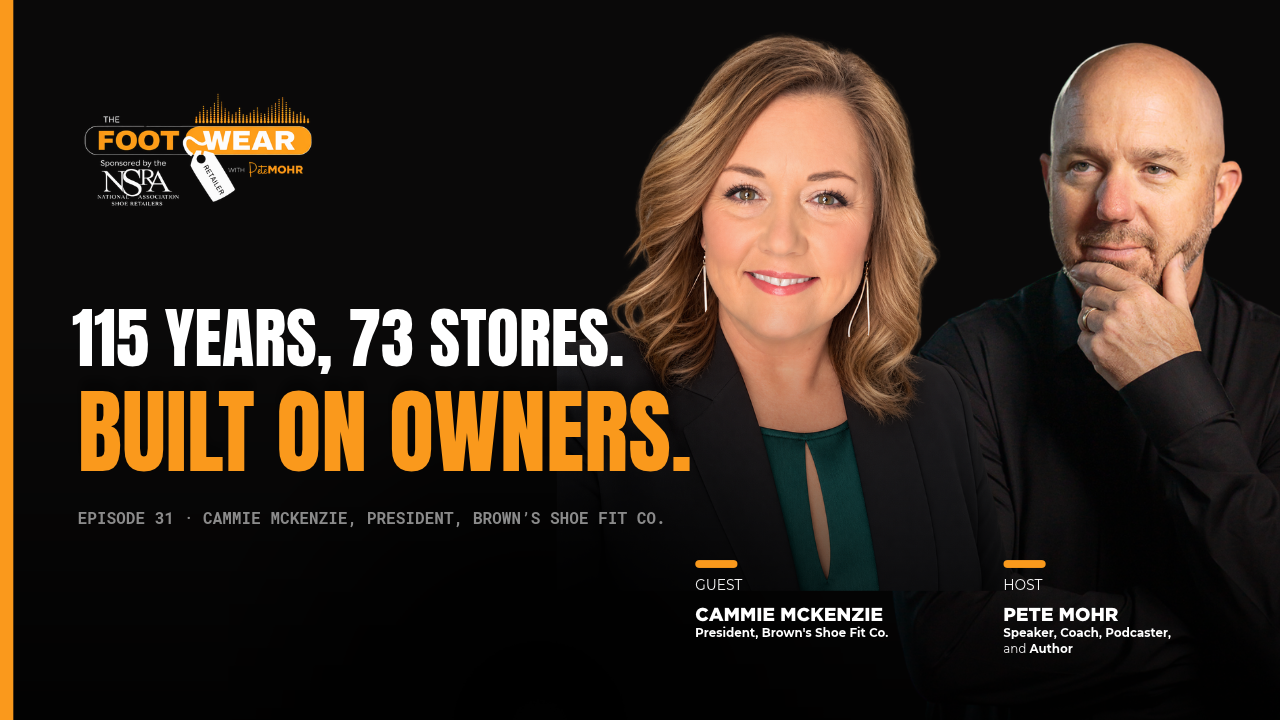
Brown’s Shoe Fit Co. President Cammie McKenzie shares how a 115-year-old footwear retailer has grown to 73 stores across 12 states by developing local owners, investing in relationships, and adapting to the changing retail landscape.
What keeps a footwear business relevant for 115 years?
Is it the products?
The number of stores?
The marketing?
Or is it something much more fundamental?
For Cammie McKenzie, President of Brown’s Shoe Fit Co., the answer starts with people.
Brown’s operates 73 stores across 12 states, but its approach doesn’t fit the traditional picture of a corporate chain. Local owner-operators make decisions about their stores and the communities they serve, while the larger organization provides support, resources, and a network of experience.
In Episode 31 of The Footwear Retailer Podcast, Cammie joins me to talk about how that model works, how Brown’s develops future owners, what it takes to lead through change, and why customer relationships still matter as retail embraces ecommerce and AI.
115 Years Later, It’s Still About People
When I asked Cammie what’s kept Brown’s relevant for more than a century, she didn’t start by talking about technology, store expansion, or product lines.
She talked about relationships.
Customers might shop online, compare prices, or discover brands in completely new ways. But independent footwear retailers have something that is difficult to reproduce through a screen: a personal connection.
They sit with customers.
They fit shoes.
They ask about families.
They remember the people who return.
That philosophy reaches beyond customers. Brown’s places a strong emphasis on honest, long-term relationships with its team members too.
People-first retail isn’t just a marketing promise. It’s part of how the business operates.
A Different Model: Creating Store Owners, Not Just Store Managers
One of the most interesting things about Brown’s is its approach to ownership.
It’s not a conventional franchise arrangement. And it’s not a system where every important decision comes from a corporate office.
Brown’s has a long-standing model that helps people become owners and operators of individual retail locations. Cammie traces the idea back to the company’s early years, when its founder helped a partner get started by financing a store and giving that person the opportunity to run it.
That philosophy continues today on a much larger scale.
Local owners can choose the products they carry and hire their own teams. The corporate organization helps with resources and buying power, but owners make the everyday decisions that shape their stores.
A store serving a college town may have a very different customer from one in a smaller community with an older population. Brown’s model makes room for those differences.
Consistency matters. But understanding your community matters too.
From Part-Time Retail Employee to Business Owner
How do you find the next generation of store owners?
Sometimes they’re actively looking for an ownership opportunity. Brown’s can bring those people into its training process with that goal in mind.
Other times, they’re already working in a store.
Cammie describes people who started as part-time employees while they were in high school, went off to college or took a different path, and eventually discovered that store ownership could be their future.
The company has developed a training program for aspiring owners and added a federally recognized apprenticeship program. The apprenticeship provides an accreditation participants can carry into other businesses, even if they ultimately decide Brown’s isn’t the right fit.
But completing training is only part of the process.
Cammie looks for people who genuinely enjoy helping others, can motivate themselves, and are willing to accept the risks of operating a retail business.
They’re not simply filling a management position.
They’re taking responsibility for a business.
For independent footwear retailers thinking about succession, there’s an important question here: Could your next owner already be on your sales floor?
No One Is Completely Ready for Ownership
One of Cammie’s most revealing observations is that nobody is ever entirely ready to take ownership of a store.
You can provide training.
You can share best practices.
You can introduce the numbers and explain the processes.
But some lessons only come from actually making decisions and learning from the results.
Brown’s reduces some of that risk through mentoring and a network of store operators who can help one another. New owners receive structured support during their first two years, and the broader network remains a source of advice afterward.
If one store makes an inventory purchase that doesn’t work for its community, for example, another store in the network may be able to sell the product more successfully.
That’s a benefit of scale without taking away local responsibility.
Ownership means having skin in the game, but it doesn’t have to mean figuring everything out alone.
The Roof Collapsed. Then Brown’s Moved Its Headquarters.
Growing a long-established company also means knowing when something needs to change.
For years, Brown’s headquarters was based in rural Shenandoah, Iowa, where the business had deep roots. Its original retail location dated back to 1911.
But the organization had outgrown its space. Employees were spread across buildings, access to resources was more difficult, and shipping from the warehouse was expensive.
Leadership had talked about moving for years.
Then a heavy snowfall caused the roof of one of the old buildings to collapse.
Suddenly, a decision that had been discussed for a long time became much more urgent.
Brown’s ultimately relocated its headquarters roughly two and a half hours away, to the Des Moines area.
The move created opportunity, but it also came with difficult consequences. Not every longtime employee could relocate. Cammie describes arriving with approximately half of the staff and having to hire and train new team members while keeping the business operating.
There were people who had spent decades learning the Brown’s way, and that institutional knowledge could not be replaced overnight.
Yet the new team also brought fresh energy and access to a wider talent pool.
Cammie recalls a small group working through the weekend to assemble desks, organize the warehouse, and get the new headquarters ready for employees arriving Monday morning.
It’s a powerful example of the difference between having a plan and leading people through the reality of change.
Control the Controllables
Footwear retailers can’t control everything affecting the business.
Economic uncertainty.
Tariffs.
Rising costs.
Changing customer traffic.
But they can control what happens within their own stores.
Cammie shares a phrase that came from one of Brown’s store operators during COVID: control the controllables.
That means concentrating on serving the customers who come through the door, managing the inventory you buy, and making good decisions with the information available.
Brown’s is constantly thinking about markup, open-to-buy decisions, and how to avoid excess merchandise that ultimately needs to be discounted.
Because its corporate office handles bills for the stores, the company also has to help owners stay disciplined about purchasing decisions without eliminating their local buying authority.
The challenge is finding the right balance between freedom and financial responsibility.
Marketing 73 Stores Without Becoming Cookie-Cutter
One marketing strategy doesn’t necessarily work for every community.
Cammie explains that direct mail may perform well in one market, while YouTube advertising or another digital approach makes more sense in another.
The customer base can vary considerably between locations. Some communities have more families, some skew older, and others include large student populations.
Brown’s has increased its investment in marketing and is paying more attention to promoting the Brown’s name alongside the footwear brands its stores carry.
The business creates common marketing materials and works toward a recognizable customer experience across its locations.
But individual owners still have a say in what they use.
Cammie recognizes that this flexibility can be both a strength and a challenge.
The aim isn’t to make every Brown’s location identical. It’s to create a consistent identity while allowing stores to reflect the customers they serve.
Making Ecommerce ‘Local Anywhere’
How does a footwear retailer built around personal fitting and local service create a meaningful online shopping experience?
That was a challenge for Brown’s when the company launched its ecommerce operation.
With 73 stores carrying different inventory, building a unified website was already complicated. And moving headquarters at around the same time didn’t make it easier.
But Cammie describes an idea that helps connect the digital business to the company’s local roots: local anywhere.
A customer can buy a pair of shoes online, but the order is still fulfilled from an individual Brown’s store. Someone at that store checks the product, packages it, and sends it out.
If the shoes don’t work, the customer can arrange a return, including through a store.
The goal is to extend the reach of local stores rather than replace them with an entirely separate online operation.
For independent retailers considering ecommerce, it’s an interesting way to think about the channel: How can digital shopping support the customer relationships and inventory strengths you already have?
Using AI to Make Better Retail Inventory Decisions
Artificial intelligence is another area where Brown’s is beginning to see opportunities.
Cammie isn’t presenting the company as an AI expert. She says the team is still learning how to use the technology and ask better questions.
But the potential is clear.
With 73 stores, the organization has a tremendous amount of data. One region may have products that are moving quickly while another has the same merchandise sitting on shelves.
In the past, it could take so long to combine and interpret that information that the opportunity to act had already passed.
AI offers a way to analyze information more quickly so team members can spend less time building reports and more time making decisions.
That’s an important distinction.
The objective isn’t to collect more data. It’s to use the data you already have while there’s still time to act on it.
And even if you’re operating one or two stores rather than 73, there’s value in asking how technology could help you better understand inventory, customers, and business performance.
A Leadership Lesson: Vulnerability Is Not Weakness
Near the end of our conversation, I asked Cammie to share one of the most important leadership lessons she has learned.
Her answer was vulnerability.
For years, she felt pressure to appear strong and to have the answers, particularly as a woman working in an environment that had long been dominated by men.
Over time, she realized the opposite approach could be more effective.
When a leader is willing to admit they don’t know everything, others feel more comfortable asking questions, sharing concerns, and requesting help.
That creates room for the entire team to contribute.
It’s especially relevant in an organization that asks people to take ownership and make decisions. No one person can have every answer across 73 different stores and communities.
Strong leadership isn’t about being the only person who can solve a problem. It’s about building a team that can solve problems together.
My Takeaway: Build a Business That Can Outlast You
What stood out to me throughout this conversation wasn’t simply Brown’s store count or its longevity.
It was the way the organization connects growth to opportunity.
Employees can become owners.
New owners have mentors.
Local operators know their customers.
Stores can support one another.
The corporate team provides tools without making every community follow an identical playbook.
And even a 115-year-old business is willing to rethink its headquarters, marketing, ecommerce, and technology.
For anyone running an independent footwear store, I think there are some worthwhile questions to ask:
- Could someone on your current team become a future owner or business leader?
- Do your managers have enough responsibility to develop real decision-making skills?
- What training and mentorship would make a transition to ownership more successful?
- Are your inventory decisions based on the needs of your local customers?
- Are you focusing enough on the things you can control inside your four walls?
- Does your marketing communicate why customers should shop with your store, not just the brands you sell?
- Could ecommerce extend your local customer experience instead of competing with it?
- Are you using the information you already have to make better decisions?
- Can your team ask for help without feeling that they’ve failed?
Those questions matter whether you have one store, two stores, or 73.
Brown’s story is a reminder that lasting businesses aren’t built by one person making every decision.
They’re built by developing people who can carry the business forward.
Listen to my full conversation with Cammie McKenzie to hear more about Brown’s unique ownership model, leadership through change, retail marketing and inventory challenges, its approach to ecommerce and AI, and why putting people first still matters after 115 years.
▶️ Watch Episode 31 on YouTube
🎧 Listen to Episode 31 on Buzzsprout

0 Comments