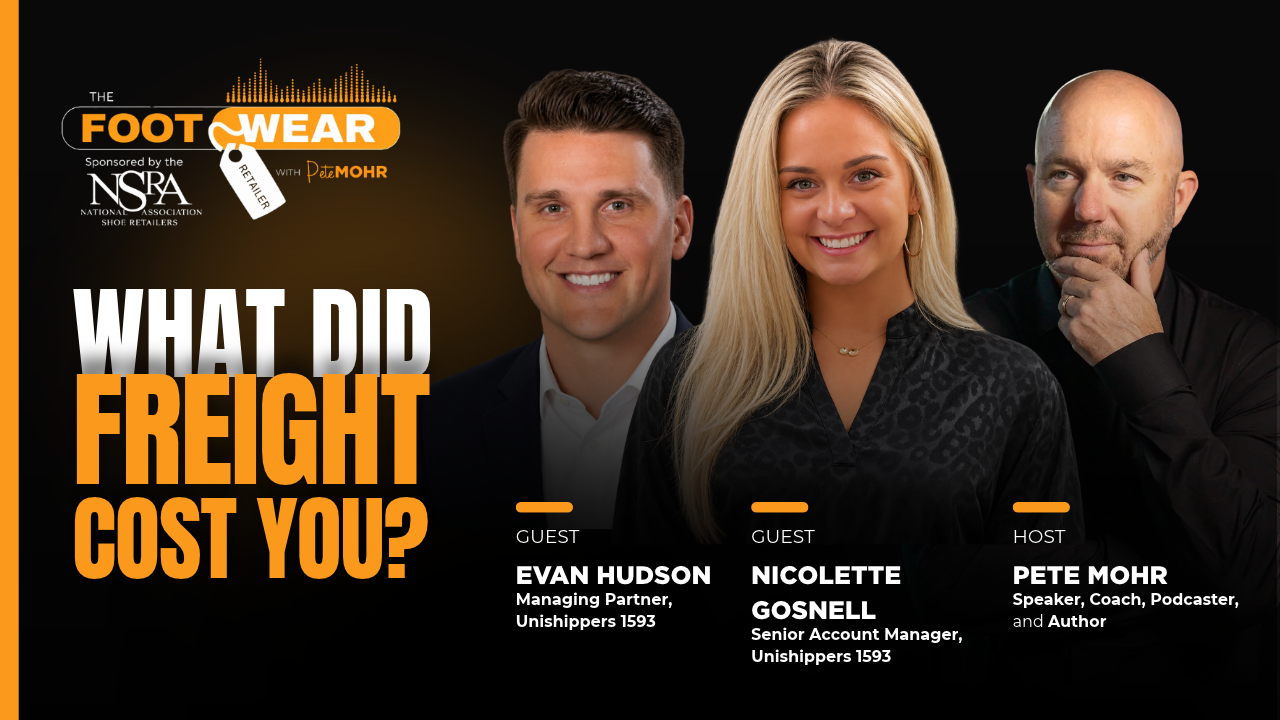
Unishippers’ Evan Hudson and Nicolette Gosnell share how independent footwear retailers can reduce shipping costs, manage freight expenses, improve profit margins, and make smarter decisions about inbound deliveries and ecommerce shipping.
How much are you really spending to get shoes into your store?
Most independent footwear retailers know what they paid for their latest order of Brooks, New Balance, Birkenstock, or another footwear brand.
They know the wholesale cost.
They know the retail price.
And they have a pretty good idea of the margin they expect to make.
But ask what it cost to ship those shoes into the store, and the answer isn’t always so clear.
That’s a problem.
Because freight isn’t just another expense buried in your profit and loss statement. It’s part of your cost of doing business, and it’s one of the expenses you may have more control over than you realize.
In Episode 32 of The Footwear Retailer Podcast, I sit down with Evan Hudson and Nicolette Gosnell of Unishippers to talk about one of the most overlooked opportunities for independent footwear retailers: reducing shipping and freight costs.
We discuss inbound shipments, freight routing, UPS surcharges, dimensional weight, ecommerce shipping, the NSRA member program, and the practical steps every retailer can take to better understand their shipping expenses.
And the biggest lesson is simple:
If you aren’t paying attention to your freight costs, you may be leaving money on the table.
Start by Looking at the Freight Line on Your P&L
One of the first things I encourage footwear retailers to do is open their profit and loss statement.
Find the freight expense.
Look at how much you’re spending.
And ask yourself whether you really understand what’s behind that number.
Many independent retailers spend a great deal of time negotiating product costs, managing payroll, and evaluating sales performance.
But shipping can get overlooked because it’s often handled automatically.
A vendor sends the product.
The shoes arrive.
The invoice gets paid.
And everyone moves on.
Meanwhile, those freight charges continue affecting your margins.
Evan points out that large retail organizations often have dedicated logistics teams responsible for managing inbound shipments, negotiating rates, and optimizing transportation expenses.
Independent footwear retailers don’t always have those resources.
When you’re running one or two locations, you’re already juggling buying, staffing, merchandising, customer service, and everything else involved in operating a store.
Freight management can easily fall to the bottom of the list.
That’s where understanding your available options becomes important.
Why Your Vendor’s Shipping Rate May Not Be Your Best Rate
One of the biggest opportunities Evan identifies is taking more control over how inventory gets shipped from suppliers to stores.
Many retailers simply accept the shipping method selected by their vendors.
In some cases, the vendor pays the carrier and adds the freight charge to the retailer’s invoice.
This is often called prepay and add.
It’s convenient.
But convenience doesn’t necessarily mean you’re receiving the best available shipping rate.
Evan explains how retailers may be able to use their own negotiated shipping arrangements instead.
Through the Unishippers program, vendors can ship using a retailer’s designated UPS account, allowing the shipment to be billed under the retailer’s negotiated pricing arrangement.
The goal is to reduce the amount paid to move inventory from the supplier to the store.
That matters because the cost of getting merchandise into your business affects the true cost of your inventory.
Saving money on freight can improve your margins without requiring you to sell more shoes.
Small Parcel or LTL? Choosing the Right Shipping Method
Not every shipment should move the same way.
For smaller fill-in orders, traditional parcel delivery through UPS or another carrier may make the most sense.
But larger shipments create a different opportunity.
Evan explains the potential advantages of LTL shipping, which stands for less-than-truckload.
With LTL, shipments that don’t require an entire truck can share transportation capacity with other freight.
Depending on shipment size, weight, location, and carrier pricing, this can be a cost-effective alternative to sending numerous individual packages.
However, there are important considerations.
Does your store have a loading dock?
Will the delivery require a liftgate?
Can the driver unload the shipment safely?
Do you have employees available to receive the merchandise?
Is your location convenient for the freight carrier?
These details matter.
As I mentioned during the conversation, our own shoe stores don’t have loading docks, so we need to make sure deliveries are arranged appropriately.
Nicolette explains that these factors are reviewed when developing a shipping plan for each retailer.
The objective isn’t simply to choose the cheapest rate on paper.
It’s to choose the shipping method that makes the most sense for the actual store receiving the merchandise.
Why Every Footwear Retailer Should Have a Routing Guide
A routing guide is one of the practical tools discussed throughout this episode.
Essentially, it tells your vendors how you want your merchandise shipped.
That may include which carrier to use, which account to bill, and when a shipment should move through small parcel service versus LTL freight.
Without clear instructions, different vendors may use different shipping methods, creating inconsistent costs.
Nicolette explains that Unishippers helps retailers develop a routing guide based on their locations, shipping needs, and vendor relationships.
The process begins with understanding how the retailer currently receives inventory.
Are freight charges appearing directly on vendor invoices?
Is the retailer already managing shipments through a carrier account?
What brands are being purchased?
How frequently are orders arriving?
And what delivery limitations exist at each location?
Once those details are understood, Nicolette and her team can help establish the routing instructions and communicate them to vendors.
That last part is particularly interesting.
Instead of leaving store owners to contact every supplier individually, the team helps coordinate the vendor communication.
For a busy independent footwear retailer, reducing the administrative work involved in making a change can be just as valuable as finding a better shipping rate.
The Hidden Shipping Charges That Can Hurt Your Margins
Years ago, shipping negotiations were often relatively straightforward.
You started with a carrier’s published rate.
You negotiated a percentage discount.
And you could make a reasonable estimate of what your shipping costs would look like.
According to Evan, that process has become considerably more complicated.
Today, retailers need to pay attention to charges beyond the basic transportation rate.
These can include:
- Dimensional weight charges
- Fuel surcharges
- Residential delivery fees
- Delivery area surcharges
- Additional handling charges
- Third-party billing fees
- Peak or demand surcharges
Each additional charge can affect the final cost of a shipment.
And because those fees may change over time, a shipping arrangement that was competitive previously may not be as attractive today.
A good discount on the base shipping rate doesn’t automatically mean you have the lowest total shipping cost.
Why Dimensional Weight Matters So Much in Footwear
One of the most useful technical details Evan explains is dimensional weight.
Footwear provides a good example because shoe boxes take up a meaningful amount of space compared with their actual weight.
Carriers may calculate a billable weight based on the dimensions of a package rather than only its physical weight.
This means a carton containing relatively lightweight footwear can be billed at a higher weight because of the space it occupies.
Evan explains that a package containing multiple pairs of shoes might have an actual weight of around 30 pounds but a much higher dimensional billable weight, depending on its measurements and shipping agreement.
That difference can significantly affect what the retailer pays.
It’s one reason he emphasizes reviewing more than just the percentage discount offered by a carrier.
Dimensional weight rules, surcharges, and other contract details can be just as important.
For footwear retailers regularly receiving cartons of shoes, understanding those charges can reveal opportunities that aren’t obvious from looking at the base rate alone.
How the Unishippers Program Helps Independent Retailers
Unishippers works with businesses that don’t necessarily have the shipping volume or internal resources of major retail chains.
Evan explains that the organization uses negotiated carrier relationships and aggregated buying power to provide shipping arrangements for its customers.
During our conversation, he describes how Unishippers has negotiated pricing structures designed around common footwear shipping patterns.
That includes heavier inbound shipments from vendors and smaller residential shipments associated with ecommerce.
Nicolette works with NSRA members and helps retailers analyze existing shipping expenses, identify opportunities, and establish a suitable routing process.
For a retailer who has never looked closely at freight costs, even the initial analysis can be informative.
It can reveal where costs are concentrated, which vendors generate unusually high freight expenses, and whether different shipping arrangements may be worth considering.
And because the program is structured around independent retailers, the goal is to make those resources accessible without requiring every store to become a shipping expert.
Ecommerce Shipping: Can Independent Shoe Stores Compete?
We also spend time discussing outbound shipping.
More independent footwear retailers are selling online, which means shipping isn’t only about bringing inventory into the store anymore.
It’s also about getting shoes from the store to the end customer.
And that’s where the economics can become challenging.
Think about the costs associated with making an online sale.
You may have advertising expenses.
Payment processing costs.
Packaging materials.
Employee time.
And the cost of shipping the product.
If it costs too much to ship a pair of shoes across the country, a seemingly profitable order may become far less attractive.
Evan discusses the relationship between Unishippers and ShipStation and how shipping technology can support smaller retailers interested in expanding their ecommerce operations.
The opportunity isn’t limited to large organizations.
A single-store footwear retailer may be able to reach customers beyond its immediate geographic market.
But to do that profitably, shipping costs need to fit the business model.
I’ve spoken with retailers who tried ecommerce in the past and questioned whether the economics made sense after accounting for advertising and delivery expenses.
Improving shipping costs may be one reason to revisit those numbers.
It’s not enough to make online sales. You need to understand what those sales actually contribute to your bottom line.
Should an Independent Shoe Store Offer Free Shipping?
Free shipping is something many online customers have come to expect.
But does that mean every independent footwear retailer should offer it?
When I asked Nicolette directly, her answer was cautious.
Not every small business can afford to absorb shipping costs on every order.
And that’s an important reality.
Free shipping isn’t actually free for the retailer.
Someone still pays the carrier.
The question is whether the business has sufficient margin to absorb that expense.
Nicolette suggests a more strategic approach.
Instead of automatically offering free shipping all the time, retailers can evaluate the savings achieved through better shipping arrangements and consider using some of that money for targeted promotions.
That might mean a free-shipping campaign during a particularly busy sales period or a special marketing initiative designed to encourage additional purchases.
The right answer depends on the store’s pricing, margins, customer base, and shipping costs.
For independent retailers, the objective should be a profitable customer experience rather than simply matching every promotion offered by a larger competitor.
Review Your Vendors: Where Is Freight Costing You the Most?
One of the most actionable suggestions from this episode is to review freight costs by vendor.
Not every supplier will generate the same shipping expense.
Geography plays a role.
Order size matters.
Shipping frequency matters.
And the method used to move merchandise can make a significant difference.
Evan gives an example of comparing vendors where freight might represent three or six percent of merchandise cost with another supplier where that percentage is closer to twelve percent.
Those numbers are illustrative, but the lesson is important.
If one vendor’s shipping costs are significantly higher than others, that supplier deserves a closer look.
Perhaps the vendor is located across the country.
Perhaps the store is placing too many small orders.
Or perhaps a different transportation method would be more efficient.
In some cases, consolidating orders into larger shipments may reduce the average freight cost per pair.
But you need the information before you can make that decision.
The first step toward reducing shipping costs is identifying where the costs are coming from.
What Information Do You Need for a Shipping Analysis?
Nicolette explains that retailers don’t necessarily need to complete an enormous project before evaluating their freight expenses.
The starting point depends on how they currently pay for shipping.
If freight charges are added to vendor invoices, she suggests gathering a representative selection of invoices from different suppliers.
She mentions approximately fifteen invoices as a possible minimum starting point, with more being useful when a store works with many brands.
If the retailer already has its own carrier account, recent shipping bills can help establish a picture of current costs.
Nicolette suggests reviewing roughly 30 to 60 days of billing information.
That provides a foundation for comparing the existing shipping setup with other available options.
And perhaps the most important point is that the process doesn’t need to consume a huge amount of the retailer’s time.
Gather the information.
Understand the current costs.
Identify the opportunities.
Then determine whether making a change is worthwhile.
Don’t Wait Until Next Year to Review Shipping Costs
Another point Nicolette raises is timing.
Retailers sometimes assume that reviewing carrier agreements and shipping expenses should happen at the beginning of a new year.
But waiting may mean missing opportunities during important selling periods.
In our conversation, Nicolette encourages retailers to consider reviewing their shipping arrangements before the holiday season rather than automatically putting the task off until the first quarter.
Evan also discusses carrier rate adjustments, residential surcharges, rural delivery charges, and seasonal demand fees.
These costs can change, which is why a rate review from a year or two ago may no longer tell the whole story.
For store owners, that reinforces a simple principle:
Freight management should be an ongoing part of reviewing business expenses, not a once-every-few-years exercise.
What About Canadian Footwear Retailers?
Because The Footwear Retailer Podcast reaches listeners on both sides of the border, I also asked whether the Unishippers program could support Canadian retailers.
Evan explains that the domestic small-parcel program discussed in this episode focuses on businesses in the United States.
He also notes that certain Canadian LTL freight opportunities may be evaluated separately.
For Canadian retailers interested in the program, the important step is to confirm which services are available for their specific location and shipping requirements.
A Family Business Built Around Complementary Strengths
Beyond shipping, there’s another interesting business story in this episode.
Evan works alongside his brothers in the Unishippers business.
He explains that one of his older brothers entered the industry in the early 2000s, and the family eventually developed the business together.
Family businesses bring their own challenges.
Personal relationships can make disagreements more complicated.
But Evan believes the key is understanding what each person does well, keeping a common goal in mind, and trusting people to do their jobs.
It’s a leadership lesson that applies just as much to independent footwear retail.
If you’ve hired capable people, you need to give them room to use their strengths.
Trying to control every decision can prevent the business from developing beyond the owner.
Whether you’re managing family members or an experienced retail team, trust and clear responsibilities matter.
Sometimes the Best Savings Come From Letting Experts Help
One of the final ideas from this conversation is something I believe strongly.
As footwear retailers, we’re shoe experts.
We understand products.
We understand fitting.
We understand customers.
And we know how to run our stores.
But that doesn’t automatically make us freight experts.
Evan makes the point that chasing every last dollar of savings isn’t always the best use of a business owner’s time.
Sometimes working with the right outside partner makes the business more efficient because it allows your team to focus on the work it does best.
That’s an important distinction.
You should absolutely understand your costs.
You should look for opportunities to improve your margins.
But you should also recognize when someone else’s expertise can help you achieve those results more effectively.
My Takeaway: Your Freight Expense Deserves More Attention
One of the things I enjoyed most about this conversation with Evan and Nicolette is how practical the lessons are.
We’re not talking about some complicated new retail concept that requires you to rebuild your business.
We’re talking about understanding an expense you’re already paying.
Looking at your invoices.
Questioning the shipping methods you’re using.
Comparing vendors.
Reviewing surcharges.
And making sure your shipping arrangements support the business you’re trying to build.
For independent footwear retailers, I’d encourage you to ask yourself a few questions:
- Do I know how much my store spends on freight each year?
- Am I including inbound shipping costs when evaluating product profitability?
- Which vendors have the highest freight costs relative to merchandise purchased?
- Am I automatically accepting the shipping rates selected by suppliers?
- Would a routing guide help bring more consistency to our deliveries?
- Are we choosing the right method for larger seasonal shipments?
- Do I understand dimensional weight and the other surcharges appearing on our bills?
- Have I reviewed our shipping agreements recently?
- Does our ecommerce shipping strategy make financial sense?
- Could a specialist help us reduce costs while freeing up our team’s time?
These questions are relevant whether you operate one independent shoe store or a growing multi-location business.
And the answers may reveal opportunities you haven’t considered before.
Here’s what I’d encourage you to do after listening to this episode:
Pull out your freight numbers, take a closer look at what you’re spending, and find out whether your current shipping process is really working for your business.
You don’t necessarily need to sell more shoes to improve your profitability.
Sometimes you just need to pay closer attention to what it costs to get those shoes into your store and out to your customers.
Listen to my full conversation with Evan Hudson and Nicolette Gosnell of Unishippers to learn more about freight cost analysis, vendor routing, shipping surcharges, ecommerce fulfillment, and how independent footwear retailers can make smarter shipping decisions.
▶️ WATCH THE FULL EPISODE ON YOUTUBE
🎧 LISTEN TO EPISODE 32 ON BUZZSPROUT

0 Comments