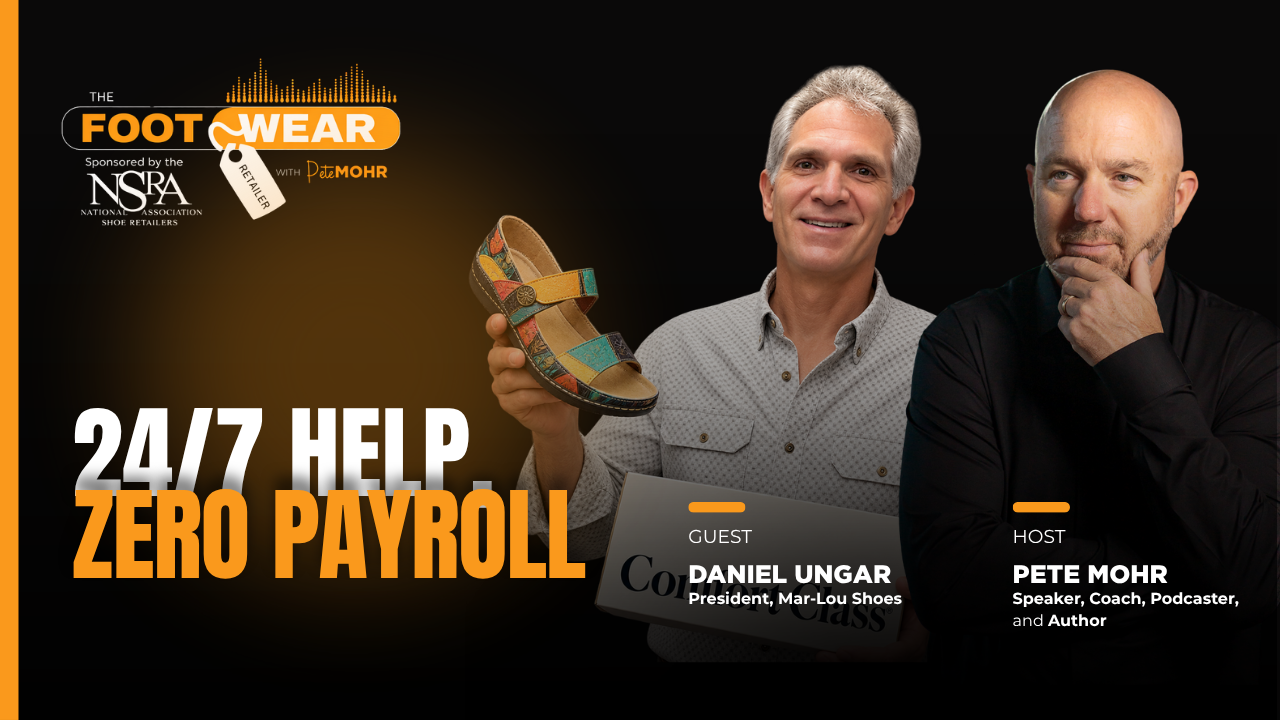
Dan Ungar of Mar-Lou Shoes on how independent footwear retailers can use AI to make better buying decisions, analyze inventory, understand customers, improve marketing, and turn years of retail data into answers they can actually use.
Independent footwear retailers aren’t short on data.
We have sales reports. Inventory reports. Customer histories. Margins. Turn rates. Brand performance. Size runs. Open-to-buy calculations.
The challenge has always been turning all that information into a clear answer to a simple question:
What should I do next?
For Dan Ungar, president of Mar-Lou Shoes in Lyndhurst, Ohio, artificial intelligence is beginning to change that.
Dan isn’t approaching AI as a replacement for decades of footwear experience. He’s treating it like an assistant — one that can analyze information, answer questions, challenge assumptions, and help him make better-informed decisions.
In Episode 28 of The Footwear Retailer Podcast, Dan and I dig into how we’re actually using AI inside our footwear businesses, where retailers can start, and why this technology may give independent stores access to capabilities that were once reserved for much larger companies.
From a 1958 Family Shoe Store to AI-Powered Retail
Mar-Lou Shoes was founded by Dan’s parents in 1958.
His father left corporate life and moved to Cleveland, where he purchased a small closeout shoe store and began focusing on a problem his own family understood firsthand: hard-to-find shoe sizes and widths.
Dan’s mother wore a particularly difficult-to-find size, and Mar-Lou built its early reputation around serving customers who struggled to find footwear elsewhere.
Over the years, the company expanded from one store to several locations before eventually consolidating into one large store on the east side of Cleveland.
Today, Mar-Lou continues to focus on proper fit, customer experience, and difficult-to-find sizes and widths.
Dan joined the family business full-time in 1989.
He’s watched footwear retail change dramatically since then.
First came the explosion of discount retailers and new places for consumers to buy shoes.
Then came the internet.
Now comes another major shift:
Artificial intelligence.
Think of AI as an Assistant, Not a Replacement
One of Dan’s most useful ways of thinking about AI is also one of the simplest.
He treats it like an assistant.
“AI is my assistant.”
For a small business owner, that’s a powerful idea.
Imagine having someone available whenever you need them to analyze a report, organize information, research a question, review a buying decision, or help you think through a problem.
Except this assistant doesn’t require another office, another salary, or a traditional work schedule.
That doesn’t mean AI makes the decision for you.
Dan makes that distinction repeatedly.
If an employee gave you a recommendation, you wouldn’t automatically follow it. You’d compare the recommendation against your own knowledge and experience.
AI should be treated the same way.
It can give you better information. You’re still responsible for the decision.
Using AI to Make Better Footwear Buying Decisions
This is where the conversation gets especially interesting for footwear retailers.
Dan has been building an AI-assisted buying system as he prepares for the Spring/Summer 2027 buying season.
The underlying retail math hasn’t changed.
Dan still has old open-to-buy worksheets from his father. The fundamentals — average inventory, turnover, initial orders, fill-ins, and other core retail calculations — remain relevant decades later.
As we put it during our conversation:
Retail math is retail math.
What has changed is our ability to process enormous amounts of information around that math.
Instead of looking at one report and then another, retailers can give AI multiple data sources and begin asking questions across them.
For example:
- Which brands are trending up or down?
- Which departments deserve more open-to-buy?
- How is a brand performing within each department?
- What happened this year compared with the previous three years?
- Where are margins improving or declining?
- Which products deserve deeper inventory?
- Where might we be overbought?
That’s a major shift.
The retailer doesn’t necessarily need another report.
The retailer needs an answer.
From Reports to Answers
Most established footwear retailers already have plenty of information sitting inside their POS systems.
The problem is that the exact answer you need may be spread across five or ten different reports.
You might need sales history from one place, inventory from another, margins from another, customer information somewhere else, and traffic data from yet another system.
Historically, getting one useful answer meant downloading reports, cleaning spreadsheets, creating formulas, combining data, and then interpreting the result.
AI can dramatically shorten that process.
Instead of asking:
Which report do I need?
You can begin asking:
What do I want to know?
That’s the important change.
At ShoeTopia, for example, I’m using AI to help connect information that previously lived in separate places.
That includes inventory, transactions, store traffic, conversion rates, margins, and other performance data.
Rather than opening several applications to understand what’s happening, the goal is a dashboard that gives me the information I need to make a decision.
AI doesn’t replace the data you’ve spent years collecting.
It makes that data easier to use.
AI Can Help You Find Customers Hidden Inside Your Data
Dan gave a great example of how specific these questions can become.
Imagine wanting to know where your highest concentration of customers for a particular brand lives.
Or take it further.
Where are the customers who buy a particular brand in a specific size and width?
Before AI, that analysis might technically have been possible.
But would you actually have taken the time to build it?
Probably not.
Now imagine discovering seven pairs of size 11 narrow shoes sitting in your back room.
You could identify customers who have previously purchased that size and create a highly targeted Klaviyo campaign specifically for them.
Maybe the audience is only 30 or 40 people.
It doesn’t need to be thousands.
If a few customers come in and purchase those shoes, the exercise may already have paid for itself.
This is where AI can help independent retailers become much more precise with both inventory and marketing.
What Am I Missing?
One of my favorite questions to ask AI isn’t particularly technical.
“What am I missing here?”
That’s powerful because business owners naturally develop blind spots.
We know our businesses extremely well, but that also means we tend to look at information through familiar patterns.
AI can examine the information you’ve provided and suggest another angle.
Maybe there’s a trend you haven’t considered.
Maybe one department is behaving differently from the rest.
Maybe your assumptions about a brand don’t line up with its recent performance.
Maybe there’s a customer segment buried inside your data that you’ve never specifically targeted.
You don’t have to accept every suggestion.
But having another perspective available whenever you want one is valuable.
You Don’t Need to Know How to Code
One of the biggest misconceptions around AI is that you need to be highly technical to benefit from it.
You don’t.
I don’t consider myself a coder.
Yet I’ve had AI produce extensive code for dashboards and other tools because I can explain the outcome I want.
I don’t need to understand every line of code it creates.
I need to understand the business problem I’m trying to solve.
For retailers who aren’t ready for that level of AI use, Dan’s advice is even simpler:
Start small.
Take a PDF, Excel spreadsheet, CSV, or report from your existing system.
Upload it.
Then ask something simple:
“Which brands performed better in the last month?”
See what comes back.
Ask a follow-up question.
Challenge the answer if something doesn’t look right.
Then keep going.
What If AI Gets Something Wrong?
This is one of the biggest concerns retailers have about AI.
And it’s a legitimate one.
AI can make mistakes.
But Dan’s comparison to a human assistant is useful here too.
If an employee brought you information that didn’t look correct, you wouldn’t assume everything that employee ever tells you is useless.
You’d question it.
You’d ask them to check their work.
You’d provide more context.
You’d continue the conversation until you were comfortable making the decision.
Do the same with AI.
Ask it to double-check.
Ask where the information came from.
Tell it what looks wrong.
Provide additional data.
And remember:
You are still the decision maker.
The Upfront Work Is Where the Long-Term Value Comes From
AI isn’t magic.
There is work involved.
Dan has invested significant time developing his buying system. I’ve rebuilt dashboards multiple times as I’ve discovered new possibilities.
But there’s an important difference between this work and many of the repetitive tasks we’ve traditionally done.
Once you’ve built a useful process, you can use it again.
And again.
And again.
That’s where the efficiency begins to compound.
The first time you build the workflow might take hours.
The next time, you may only need to ask the question.
AI May Give Independent Retailers New Horsepower
Dan saved one of his strongest observations for the end of our conversation.
“For the first time in our history, we finally have the horsepower.”
For decades, large retailers had resources most independents simply couldn’t match.
More analysts.
More technology.
More people to process information.
More resources to study customer behavior and inventory performance.
AI doesn’t suddenly make an independent shoe store the same as a national chain.
But it can give a smaller operator access to analytical and operational capabilities that previously required significantly more time, technical knowledge, or labor.
That’s a meaningful change.
Especially when independent retailers combine those tools with the advantages they already have:
Experience. Customer relationships. Product knowledge. Local reputation. Speed. And the ability to make decisions without navigating layers of corporate approval.
My Takeaway
The biggest mistake retailers can make with AI may be assuming they need to understand everything before they start.
You don’t need a sophisticated AI strategy tomorrow.
You don’t need to code.
You don’t need to automate your entire company.
Start with one report and one question.
Ask which brands performed best.
Ask what inventory isn’t moving.
Ask what you’re missing.
Then use your own experience to evaluate the answer.
Dan has spent more than three decades working full-time in his family’s footwear business.
AI hasn’t replaced that experience.
It’s giving him another way to use it.
That’s the opportunity.
Better information. Faster analysis. More useful questions. And ultimately, better-informed decisions.
Listen to my full conversation with Dan Ungar to hear how we’re using AI inside Mar-Lou Shoes and ShoeTopia, what we’ve learned along the way, and where independent footwear retailers can start.
0 Comments